

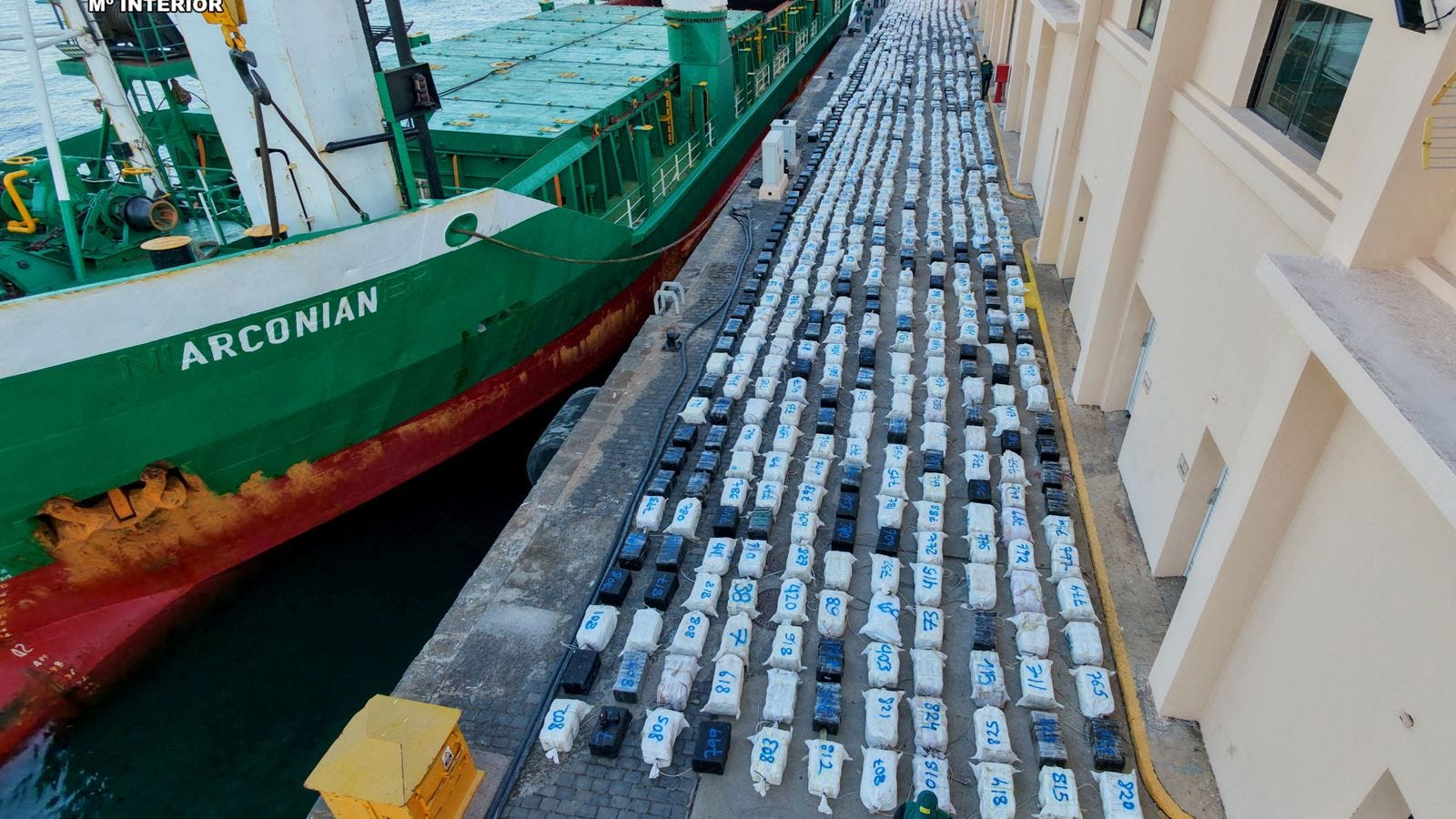
A month ago, off the coast of Dakhla in Western Sahara, the Spanish Guardia Civil boarded a Comoros-flagged dry bulk carrier called the Arconian and found 30.2 tonnes of cocaine stacked behind a hidden metal door, guarded by six armed men.
The vessel had left Freetown in Sierra Leone nine days earlier, official destination Benghazi in Libya. It was the largest single maritime cocaine seizure in history.
Wwith the Arconian still tied up in the Canary Islands, the revelations about this cargo proves how the trans-Atlantic cocaine pipeline has shifted.
This morning, I read one of the finest pieces of investigative crime work I have read in a long time. This was the Global Initiative Against Transnational Organized Crime (GI-TOC)’s report on the Arconian here. Please share and support their work widely.
What follows is my takeaways from their conclusions, it is not meant to replace their astounding forensic efforts.
Sierra Leone has stopped concealing its role in the cocaine trade and is now its most reliable Atlantic node, with the president's own family entwined in the network. Cocaine has become abundant enough that traffickers can buy entire cargo ships for a single voyage and treat them as expendable. And European trafficking organisations are evolving at industrial speed, outpacing every framework built to contain them.
1. The size of West African seizures is climbing because trafficker confidence is climbing
In 2025, the average size of a cocaine seizure in West Africa was 5.6 tons. That was more than double the 2.4 ton average seen in 2024, according to the Maritime Analysis and Operations Centre – Narcotics (MAOC-N) in Lisbon. The total tonnage Total seized on the route rose seven-fold between 2022 and 2024, reaching 352 tonnes in 2024 alone.
Individual seizures have grown.A record was set in September 2025 when the French Navy seized 9.6 tons off West Africa, this was broken by 10-ton seizure off El Hierro in the Canaries in January 2026. That record lasted four months when the Arconian was found with three times that number on board.
This is not an exact science by seizures can be used to estimate how much law enforcement caught while it was moving. With each new record, this looks like proportionally less.
However, this trajectory also measures something traffickers understand well: the cost of being intercepted, relative to the value of getting through. When that ratio falls, consignment sizes rise, because the marginal cocaine added to a single hull is essentially free once the network has paid for the vessel, the crew, the protection, and the route.
The Arconian carried no cover cargo. Its thirty tonnes of cocaine were stacked behind a hidden metal door in a long gallery, with no rice or cacao or soybean flour to disguise them. Concealment was not deemed necessary.
A network willing to load thirty tons onto one ship in plain view is a network that has, over years of successful runs, priced interception as an acceptable cost.
2. Sierra Leone has been taken over by a Dutch-led drug network
Specific institutions inside Sierra Leone have been individually purchased, one office at a time, by a Dutch-led drug trafficking network.
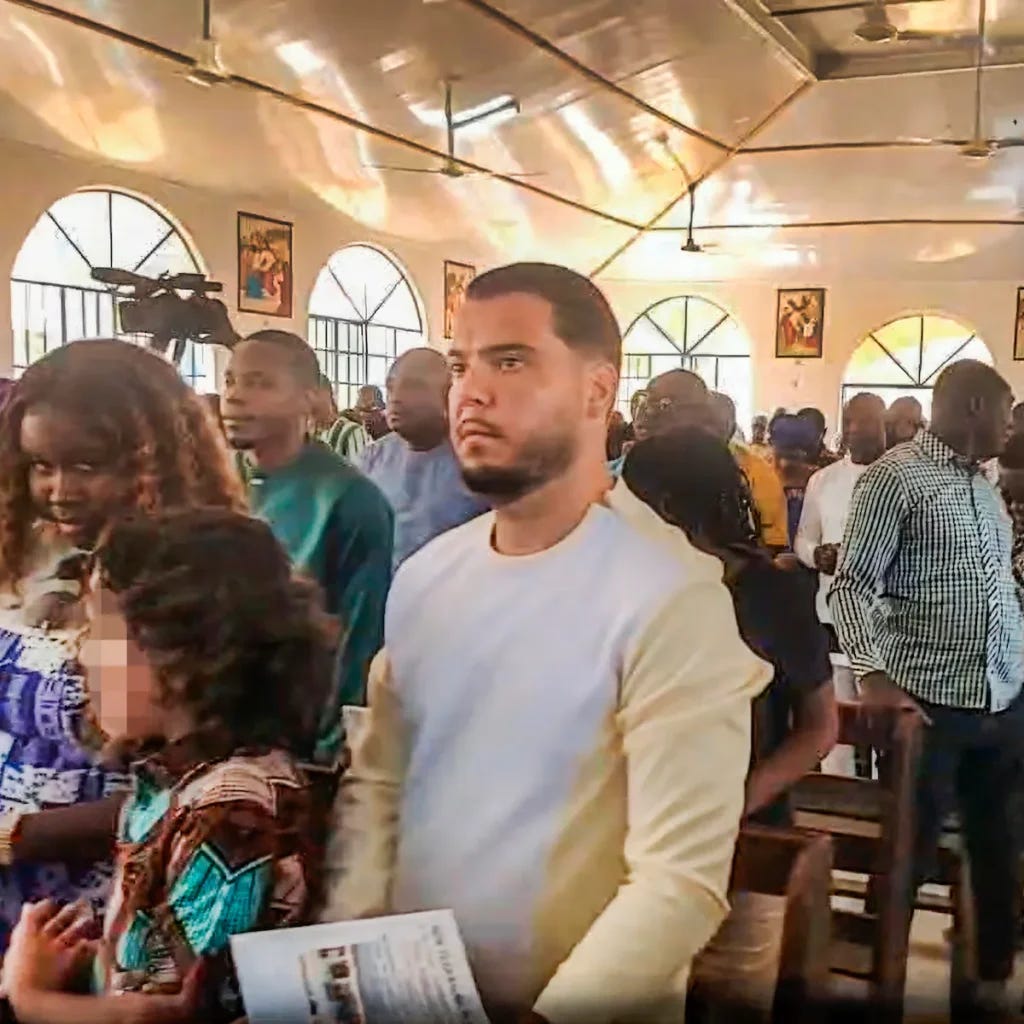
The network’s anchor is Jos Leijdekkers, a 34-year-old Dutch fugitive from Breda known as Bolle Jos, who arrived in Sierra Leone in 2022 under the alias Omar Sheriff and set up at the Two Seasons resort on the coast south of Freetown. By mid-2024 he had entered the ruling family, in a relationship with Agnes Bio, the daughter of President Julius Maada Bio, with whom he has since fathered a child. Agnes Bio held a diplomatic posting at Sierra Leone’s UN mission in New York during the same period. On 1 January 2025, footage filmed by First Lady Fatima Maada Bio and circulated on social media showed Leijdekkers seated two rows behind the president at a New Year church service in Tihun, the president’s home village.
Leijdekkers is close to many in power. In a reshuffle in August 2023, Alusine Kanneh was appointed Chief Immigration Officer; Andrew Jaiah Kaikai was appointed Executive Director of the National Drug Law Enforcement Agency; and Yankuba Bio, a close relative of the president, was made Director of the Ports and Harbours Authority, running Queen Elizabeth II Quay, the very port from which the Arconian sailed. Each of those three men has since been photographed in proximity to Leijdekkers or to vehicles associated with him. Kanneh was filmed receiving a gift at Leijdekkers’s birthday party and dismissed the day the footage went public.
The protective infrastructure is visible too. A private jet with a fake registration and disabled radar landed at Freetown International Airport in September 2024; its Mexican and Dutch crew were released after paying a $100,000 fine. Belgian customs identified Sierra Leone as the second most prominent point of origin for cocaine seizures in Belgium in 2024, according to a GI-TOC report published this month. Sierra Leone retails cocaine at €17.90 per gram, the lowest figure in West Africa, the predictable overspill from stockpiles that are too large to move discreetly. A Dutch journalist was detained outside Leijdekkers's Two Seasons resort in 2025 on suspicion of espionage. Press freedom organisations have reported bribes of up to €5,000 offered to local journalists to stop covering him.
3. Jos Leijdekkers is the prototype for a new generation of traffickers.
The simplified version of the Leijdekkers story is that a violent Dutch kid from Breda got too big for the Netherlands, fled to Sierra Leone, and got even bigger. The accurate version is that almost every cocaine trafficker of his generation took some version of that route, and only Leijdekkers came out the other end controlling a transcontinental logistics operation that the Spanish Civil Guard now estimates is moving cocaine on a scale European law enforcement had never previously documented.
His starting point was ordinary. In 2011, Leijdekkers shot two brothers in a Breda bar fight and was sentenced to six years. He met the Dutch trafficker Piet Wortel inside, and on release entered Wortel’s network, organising multi-tonne cocaine shipments through Antwerp and Rotterdam. By 2019 he was ordering kills, the disappearance of his associate Naima Jillal, photographed under torture and never found, was traced back to him. By 2020, he was instructing his enforcers to shoot an Antwerp port guard in the kneecaps for spotting one of his containers. He fled to Istanbul, then to Sierra Leone, in 2022.
The financial scale matches the operational one. A Rotterdam court ordered him in July 2025 to pay €96 million in confiscated criminal earnings, calculated from 14 cocaine shipments over less than a year. The Dutch Justice Minister told Buitenhof on 1 June 2026 that Leijdekkers earns “hundreds of millions of euros a month”. Dutch police estimate his network turns over up to €2 billion a year. He has been convicted in absentia in the Netherlands, in Antwerp, and at Dendermonde in May 2026 for a separate 11-tonne shipment.
The result is a single individual who has done what no almost no European trafficker before him managed to do: move the centre of his operation out of Europe entirely, embed it inside an African state, and run cocaine logistics at industrial scale from that base.
4. The Leijdekkers network runs across four jurisdictions a
Almost everything publicly known about how the Arconian was assembled, nd how at least two other vessels were assembled before it, comes from a single source: the report by GI-TOC, The Arconian operation. Anatomy of a record Atlantic cocaine shipment - trafficking on cargo vessels from West Africa to Europe, published a few days ago. , authored by Josef Skrdlik, Sarah Fares, and Lucia Bird. The work draws on AIS vessel tracking, ship registry analysis through Equasis, corporate mapping via Sayari and OpenCorporates, witness photographs from inside the network, and more than 190 stakeholder interviews carried out across West Africa in 2025.
The structure runs across Sierra Leone, Germany, Turkey, and the Philippines, with each jurisdiction performing a specific function.
In Sierra Leone, Leijdekkers’s network sets up single-purpose shell companies to acquire the vessels in country. The Arconian was bought in February 2026 by Serenity Shipping SL Ltd, a Freetown-registered firm with no prior shipping history and no other vessels. The ship White Eagle was bought in December 2023 by Imperial Shipping Agency SL, a similar shell. The White Labeille was bought in October 2024 by Diamond Line Shipping Ltd, for a reported US$2 million paid in advance of the ship’s arrival in Freetown.
None of the three companies had ever owned a vessel before. None has owned one since. Each was created to hold one ship for one voyage, and discarded.
In Germany, the pre-Sierra-Leonean paper trail sits at the same Flensburg address: Eckernförder Landstraße 65. The three vessels were sold to the Sierra Leonean shells by three German-registered owners, Firat Shipping Co. Ltd (the Arconian), Toprak Shipping Inc. (the White Eagle), and Zeynep Shipping Co. Ltd (the White Labeille), all sharing that address. All three vessels were managed pre-sale by a fourth company at the same address: Tunaryan Schifffahrts GmbH. GI-TOC’s mapping of Tunaryan and its associated entities found no other significant commercial presence; the cluster manages only a handful of ships in total. The Flensburg layer is what made the vessels available to be bought.
In Turkey, a single firm in Gaziantep, Nisa Uluslararası Deniz, was registered as International Safety Management (ISM) manager on all three vessels within a three-week window in August and September 2022. ISM management is a legally required role under International Maritime Organization rules.
Concentrating it in one small Turkish company across three otherwise unconnected vessels is what allowed those three vessels to be operated as a unit. Leijdekkers’s own ties to Türkiye, including a Turkish brother-in-law and his brother Harry repeatedly being arrested, sit behind that layer.
In the Philippines, a Manila-based recruitment agency, coordinated through a Filipino woman based in Freetown who regularly visited Leijdekkers’s residences, supplied the crews. Filipino sailors crewed the Arconian (17 of them, alongside six armed Dutch and Surinamese guards), the White Eagle (15, abandoned in Nador, Morocco on 1 January 2025), and the White Arrow (16, abandoned in Benghazi the same day, recorded in the ILO/IMO database of abandoned seafarers). One Filipino operations manager, with a prior career at a ship-management company, wired tens of thousands of dollars a month back to his family through Western Union.
The network that loaded the Arconian with cocaine was a deliberately distributed business, with each jurisdiction selected for what it could best provide.
5. Why was the Arconian headed to Libya?
The Arconian‘s declared destination was Benghazi, on the eastern Libyan coast, which sits inside one of the two halves of a divided Libyan state, and which half a cocaine shipment is heading toward tells you something about who was expected to receive it on arrival.
Libya has been governed by two competing administrations since 2014: the internationally recognised Government of National Unity (GNU) in Tripoli, headed by Abdelhamid Dabaiba, and a rival authority in the east based in Benghazi, dominated by the Libyan Arab Armed Forces (LAAF) under the Haftar family.
The two sides control separate territories, separate coastlines, separate port authorities, and separate illicit economies. Benghazi falls under the LAAF.
The political response to the Arconian seizure tracked that divide. Within a week, Prime Minister Dabaiba ordered an investigation into the shipment, framing it as an eastern problem. The eastern authorities responded by denying any link to the shipment threatening to suspend diplomatic relations with Spain.
The Arconian became a domestic Libyan political weapon.
GI-TOC’s vessel tracking found four other ships in the broader dossier, vessels with the same ownership patterns, the same reflagging cadence, and the same Freetown departures, that docked in Libyan ports between 2024 and 2026: Benghazi, Sirte, Misrata, and al-Khoms.
The UN Office on Drugs and Crime, in its first dedicated report on Libyan drug trafficking dynamics published in January 2026, documented Libya’s expanding role as a trans-shipment hub for cocaine moving toward Europe, the Middle East and North Africa. Research for the European Union Drugs Agency had already identified Tobruk and Benghazi as known cocaine landing sites, with onward movement by sea toward southern Italy and the Balkans.
6. Disposable vessels may be the new normal
The Arconian was 41 years old. It had spent most of its working life shuttling cement, rice, and bagged cargo between West African ports under a succession of unremarkable owners. In early February 2026, weeks before its final voyage, it was acquired by Serenity Shipping SL Ltd, a Sierra Leonean company that had never owned a vessel before and has not owned one since. The ship was bought to make one trip.
The economics are straightforward. A 30-tonne cocaine shipment intercepted by the Spanish authorities was valued by the Audiencia Nacional at €812 million. A 40-year-old general cargo vessel in West African coastal trade sells for between US$1-3 million. The ratio between cargo and ship has become absurd. They can buy the ship outright, accept that interception means losing the hull, and still come out ahead by orders of magnitude on a single successful voyage. The Leijdekkers network’s reported turnover of up to €2 billion a year makes a $2 million ship an obvious purchase.
This breaks the maritime interdiction model in two ways.
The first is operational. European law enforcement is structured around tracking known traffickers, known cargo vessels, and known shipping companies over time, the assumption being that vessels and corporate structures are persistent assets whose patterns can be mapped.
The Leijdekkers model dissolves that assumption. Each Sierra Leonean shell is created for one ship. Each ship is sailed once. Each ship’s history under previous owners is irrelevant to its final voyage. By the time a vessel’s behaviour becomes interesting enough to warrant attention, it is already mid-Atlantic with its cargo aboard.
GI-TOC was able to map the Arconian, the White Eagle, and the White Labeille together only retrospectively, once the Arconian had been seized and the wider ownership patterns became visible.
The second is structural. The age and condition of the vessels involved sit outside most modern maritime regulatory frameworks. The Arconian, the White Eagle, and the White Labeille were all built between 1985 and 1989. Each had a documented history of regulatory infractions before being acquired by the Sierra Leonean shells. The White Eagle, under its former name Breadbox Falcon, was on the Black Sea ship watch list in 2020 for repeated detentions. The White Labeille had been detained in Praia, Cape Verde in 2019 carrying 9.5 tonnes of cocaine, then sold by public tender after the investigation concluded. These are vessels the legitimate shipping economy has already discarded — and that is precisely why traffickers can acquire them cheaply enough to throw away.
The maritime interdiction system was designed for a world in which moving 30 tonnes of cocaine required logistical commitments — chartered vessels, persistent shipping companies, repeated voyages — that gave investigators something to follow. That world is gone. The new model assumes the ship will be lost, treats the hull as a one-time logistics token, and absorbs the cost in the price of the cargo. Interdiction can still catch individual vessels. What it cannot yet do is catch the network behind them faster than the network can spin up the next one.