

In the early hours of March 2, 2026, as the smoke was still rising from the February strikes that had killed Iran’s Supreme Leader and dozens of senior commanders, a radio transmission went out across the Persian Gulf.
Ships approaching the Strait of Hormuz, the narrow corridor through which one in every five barrels of oil on earth must pass, were ordered to halt. The Islamic Revolutionary Guard Corps (IRGC) declared the strait closed. Any vessel attempting passage without authorisation risked being be set ablaze.
Within 72 hours, vessel traffic through Hormuz collapsed by 95 percent. War-risk insurance was withdrawn. Brent crude surged toward $120 a barrel. The International Energy Agency called it worse than the 1973 and 1979 oil shocks combined.
But the IRGC did not just blockade the strait. It is monetising it.
Ships seeking transit have been instructed to submit their ownership details, cargo manifests, and crew nationalities to IRGC-connected intermediaries. If approved, they received a clearance code and a mandatory escort through a specially designated corridor north of Larak Island: the Qeshm-Larak passage, a route controlled entirely by the Guards.
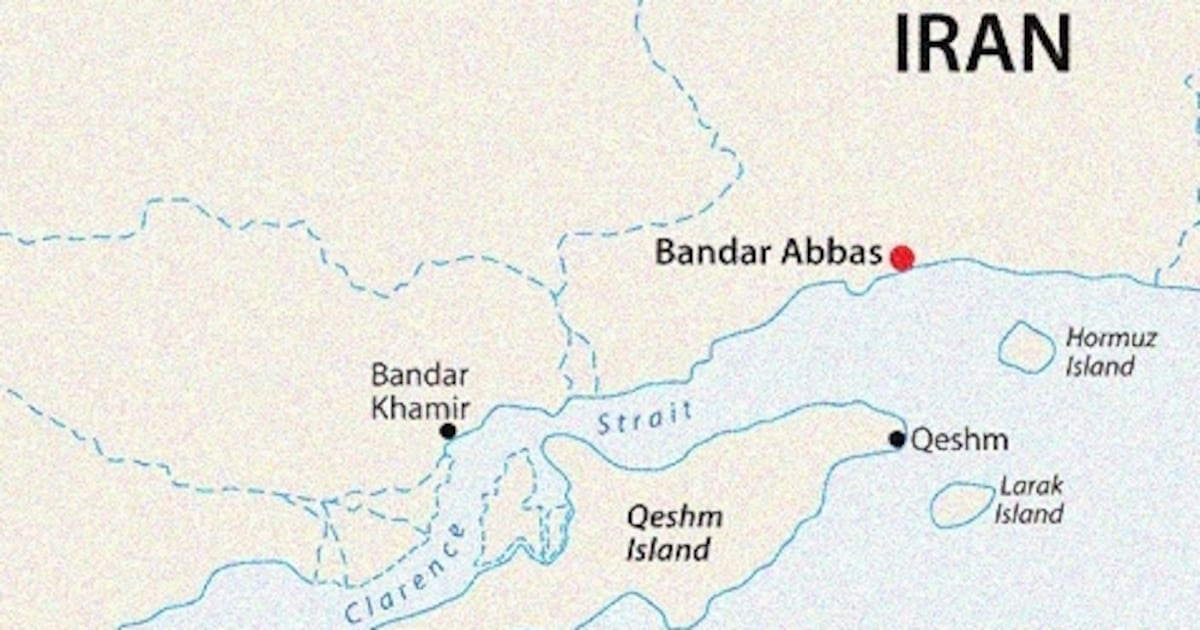
The fee for this service: $2 million per vessel, payable in Chinese yuan or stablecoins on the Tron blockchain, settling outside every Western financial system simultaneously.
By late March, Iran’s parliament had a bill in committee to codify the arrangement permanently into law. On April 7, the international acceptance of that fee became a key demand for any negotiation with the US.
This should surprise no one. For three decades, quietly and then loudly, the IRGC has been building a highly sophisticated state-backed oil smuggling operation.
Prior to the war, it controlled approximately half of Iran’s total petroleum exports, some 1.5 million barrels per day, through a ghost fleet of hundreds of tankers, a labyrinthine network of shell companies spanning dozens of jurisdictions, and a payment infrastructure that has migrated, piece by piece, entirely beyond the reach of Western sanctions.
The Hormuz toll booth is not a departure from this system. It is its logical culmination: the moment a criminal enterprise built on smuggling oil past the world’s attention decided to charge the world for looking.
The conflict has cost the IRGC dearly, however. The wartime crackdown in the UAE, long part of its central washing machine, has seen IRGC-linked money changers arrested, front companies shuttered, and the trust-based sarafi networks that moved billions disrupted in ways that analysts describe as potentially the most damaging single blow to IRGC finances in a decade.
The Venezuela channel, worth billions in stranded investments, collapsed with the capture of Nicolás Maduro. Key commanders who built and operated this architecture are dead.
Yet the oil flows on. Since the conflict began, United Against Nuclear Iran (UANI) has documented 27 Iranian oil loadings from Kharg Island, moving approximately 38 million barrels worth more than $3 billion at elevated wartime prices. The ghost fleet sails in part. The Chinese buyers are buying.
And as Iran’s conventional military is degraded, its criminal oil economy has become not a secondary revenue stream but the primary mechanism keeping the regime alive.
Even with the temporary two-week ceasefire reached on April 7 between the US and Iran, and its almost inevitable collapse. the monetization of the Strait and the oil going through it was a key negotiation demand.
Understanding how we got here requires going back to the beginning.
This is the first in a five-part series, The Criminal Empire of Iran’s Revolutionary Guard, examining how the IRGC built, operates, and is adapting one of the world’s most complex and profitable criminal enterprises. Subsequent parts will examine the IRGC’s narcotics trafficking network, its global financial architecture, its proxy criminal franchises from Hezbollah to the Houthis, and the seizure of Iran’s domestic economy. Together, they constitute the most comprehensive account in English of the IRGC as a criminal organisation rather than merely a military-political actor.
1. The paramilitary force
The Islamic Revolutionary Guard Corps was established on May 5, 1979, by decree of Ayatollah Khomeini, purpose-built as an ideological counterweight to the regular army. Its mission was to protect the revolution from enemies foreign and domestic. For its first decade, that mission was defined by the Iran-Iraq War — eight years of grinding attrition that consumed an estimated one million Iranian lives and left the country’s infrastructure in ruins.
The war’s end in 1988 created a problem. The IRGC had emerged from the conflict as Iran’s most powerful institution, commanding hundreds of thousands of battle-hardened soldiers, a formidable intelligence apparatus, and deep loyalty from the Supreme Leader. But it also had a demobilisation crisis: what do you do with a revolutionary army in peacetime?
