

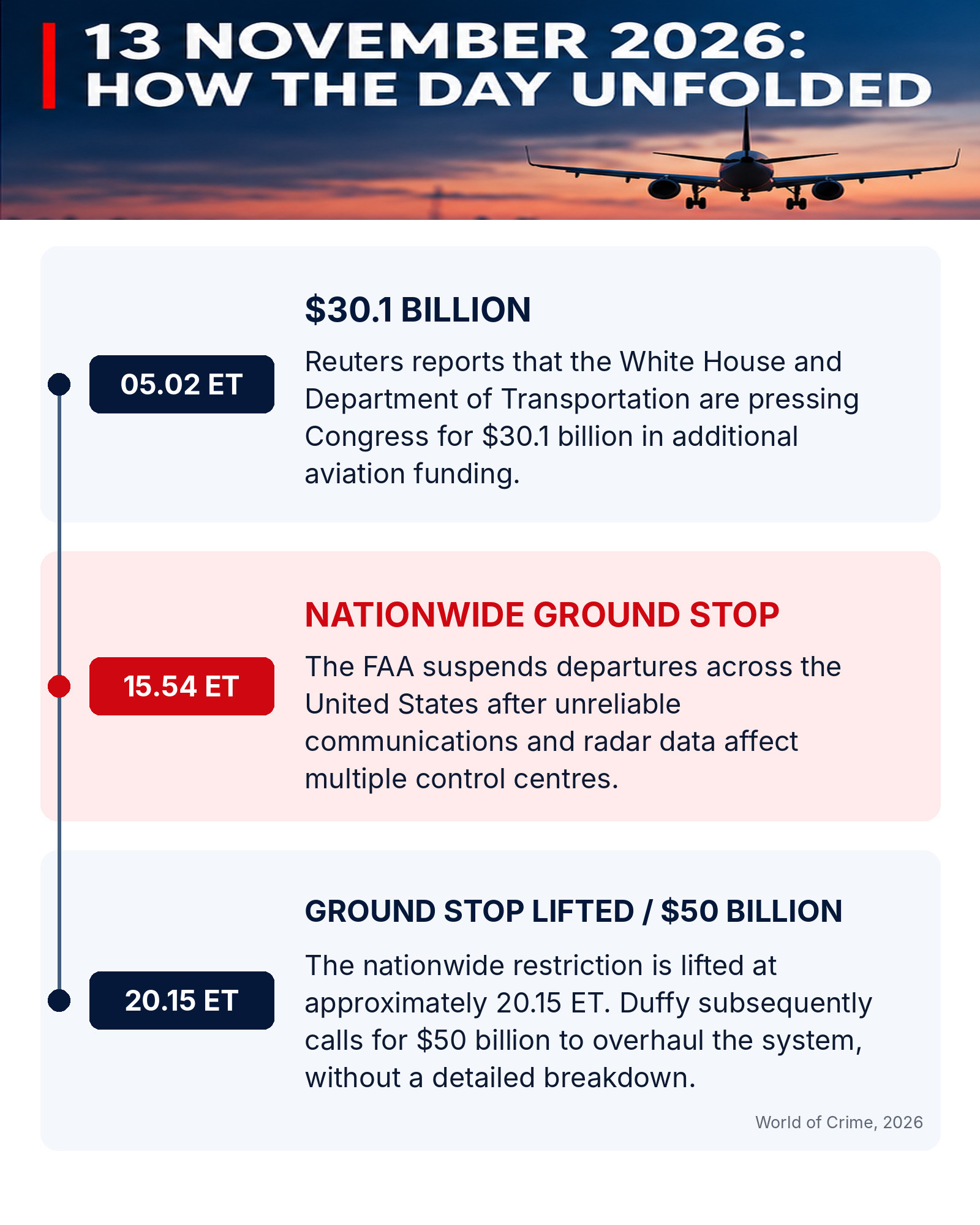
On the morning of 13 November 2026, Transportation Secretary Sean Duffy and White House budget director Russell Vought knew the exact price of fixing America’s skies. They pressed Congress for $30.1 billion in additional funding to replace decades-old radar, copper wiring and ageing control facilities.
Eleven hours later, every commercial flight in the US was grounded. Nearly 5,000 flights were cancelled and more than 10,000 delayed. It was the longest nationwide aviation shutdown since the September 11, 2001 attacks.
By that evening, Duffy knew the solution. He had been too modest. While passengers were still stranded on terminal floors, Duffy said $30 billion wouldn’t be enough. He now needed $50 billion in emergency spending.
Neither the Transportation Department, nor the FAA, nor the White House produced a single study, line item or sentence explaining how this number was reached.
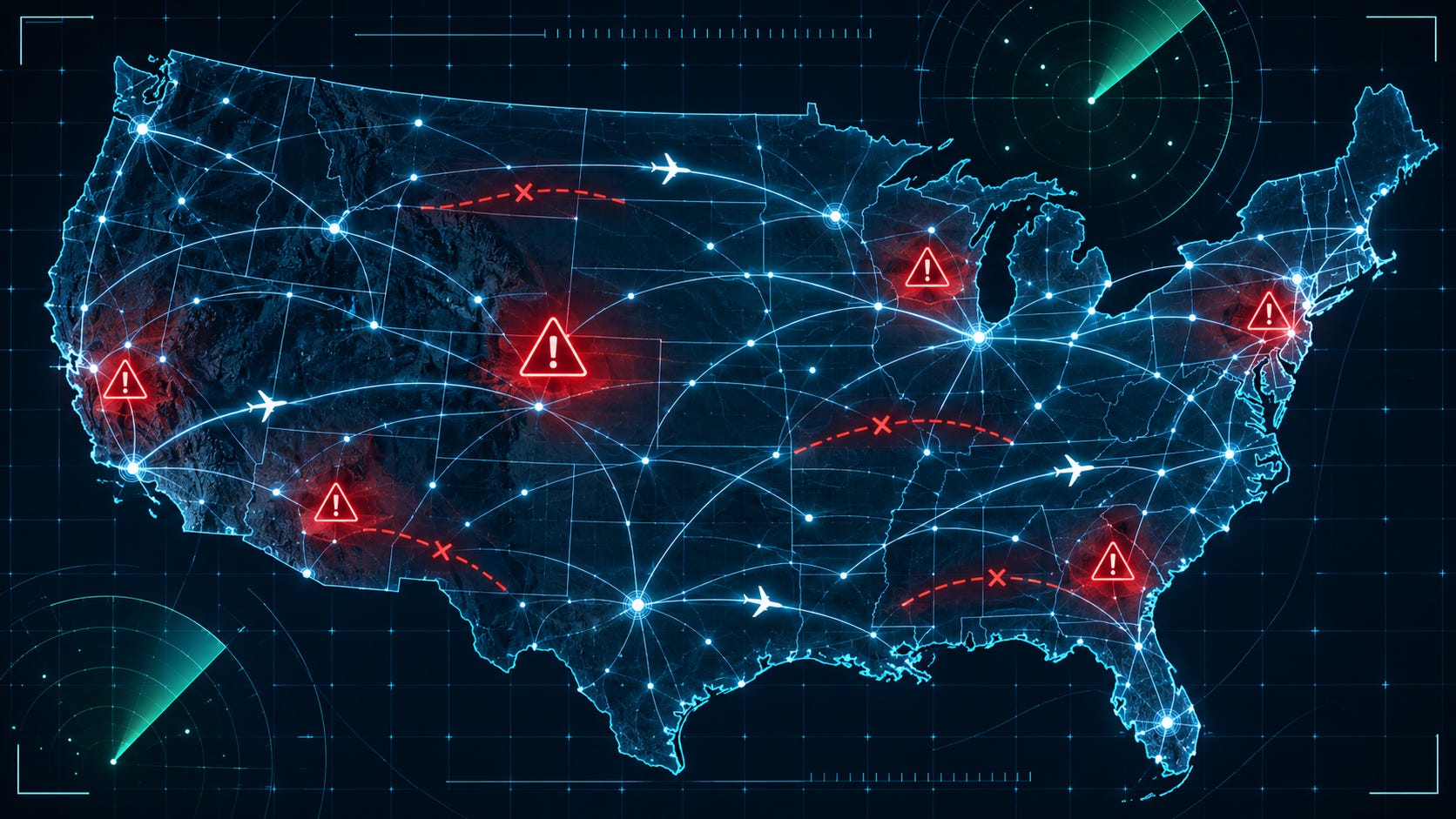
Washington immediately framed Friday’s paralysis as proof that Congress had starved the skies of cash.
The Federal Aviation Administration’s own paper trail points to a different problem. The agency has waived its procurement rules, rushed an AI rollout past all safety warnings and explored buying shares in its own software contractor before its network collapsed.
Here are a few problems I found:
1. The FAA Has Already Been Given Plenty
Washington’s claim of a cash-strapped FAA doesn’t stand up to the slightest scrutiny.
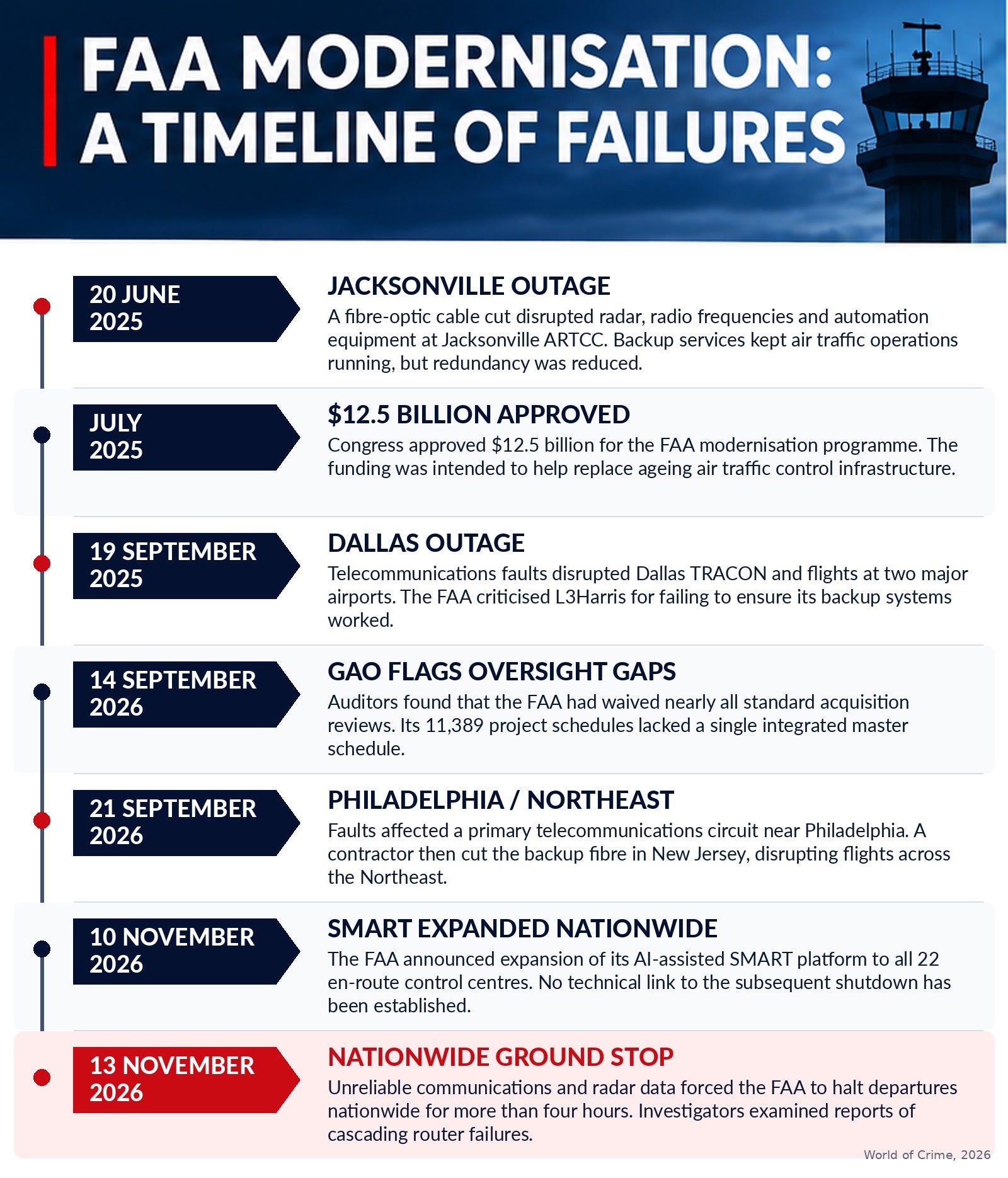
In July 2025, lawmakers appropriated $12.5 billion specifically to replace ageing air traffic control communications, radar and surveillance equipment.
Six weeks before Friday’s shutdown, on 28 September 2026, Republican Senator Eric Schmitt introduced the Modern Skies Act to provide another $30 billion for air traffic control modernisation and airport infrastructure, legislation backed by Duffy, airlines, pilots and controllers alike.
Instead, the FAA has a shocking inability to account for the money already committed. In a September audit, the Government Accountability Office found that the agency could not reliably establish the full cost of its Brand New Air Traffic Control System.
The FAA’s $10.6 billion estimate for the first phase excluded government costs, omitted most longer-term operating and maintenance expenditure and left out ann entire second phase.
When auditors asked for the underlying analysis behind the published figure, agency officials could not produce it.
That accounting failure extends a multi-decade pattern documented in the same GAO review, which noted that successive FAA modernisation programmes have suffered repeated delays and cost overruns.
Congress has repeatedly put billions on the table for aviation upgrades, only for the regulator to demand tens of billions more without showing its working on the sums already approved.
2. An AI Rollout Pushed Nationwide Despite Explicit Safety Warnings
Five weeks before Friday’s ground stop, more than two dozen lawmakers urged Duffy and FAA Administrator Bryan Bedford to halt the agency’s new artificial intelligence air traffic tool.
“I’m calling on the FAA to pause this rollout, show us the safety testing, and explain who is accountable when something goes wrong,” Representative April McClain Delaney said, warning that officials had skipped mandatory assessments for high-impact AI.
Frontline controllers had already noted their exclusion from the “design, testing, or implementation” of Air Space Intelligence’s Strategic Management of Airspace, Routes and Trajectories (SMART) platform, while 23 House Democrats requested a watchdog audit over its “reliability and safety benefits”.
The FAA ignored them. Across its modernisation drive, the Department of Transportation justified waiving nearly all standard financial, technical and security acquisition reviews by arguing that conventional rules slowed upgrades down by months or years. Applied to SMART, which analyses roughly 200 data streams to recommend flight routing changes, that impatience meant cutting short a promised 90-day evaluation at day 50 and expanding the platform across all 22 en-route control centres on 10 November without settling who is liable if something goes wrong.
Three days later, the national airspace shut down. Air Space Intelligence insisted the outage was “not based on or a result of the SMART system”, Duffy denied any link and investigators have found no technical proof tying the software to the router failure.
Yet Homeland Security Secretary Markwayne Mullin acknowledged that newly installed technology may have overwhelmed older hardware and conceded “You can’t rule out anything at this point” when asked about SMART.
3. The FAA Scrapped Its Own Rules to Rush 11,389 Projects
When the White House launched the Brand New Air Traffic Control System (BNATCS) in May 2025 to replace ageing radar, surveillance and communications kit, the FAA knew how to deal with federal red tape.
Ignore it.
After Congress approved $12.5 billion in July 2025 and the agency hired a firm called Peraton to coordinate 13 modernisation programmes by December 2028, the FAA waived nearly all its acquisition requirements.
Financial, technical, security and programme reviews were replaced with a brief list of discretionary principles calling for "sound judgement, transparency and accountability".
Last September, the GAO examined what that lighter touch had produced.
Auditors found the FAA was juggling 11,389 separate project schedules without a single integrated master schedule, planning installations at the same facilities without tracking overlapping work or system dependencies.
FAA officials acknowledged the gap, but told auditors that integrating so many projects into their scheduling system would be impractical.
Instead, the department pointed to an AI-assisted scheduling tool Peraton was still testing, which lacked any established process for resolving conflicts between installations.
The GAO warned explicitly that poorly coordinated upgrades risked causing air traffic disruptions while replacing old equipment.
Two months later, the result was clear. Duffy blamed ageing routers and switches, and Mullin suggested that newly installed equipment and technology had overwhelmed older parts of the system. Investigators still have to establish whether an uncoordinated installation triggered the cascade.
But either way, the agency had already dismantled the reviews and oversight rules designed to keep a live airspace from becoming a tech experiment.
4. The FAA Sought to Buy Shares in Its Own Software Vendor
Four months after selecting Air Space Intelligence (ASI) in June 2026 for a 12-year contract worth up to $875.9 million, the FAA sought to become a part-owner of the contractor.
On 15 October, internal FAA documents reported by Politico revealed that the agency was negotiating a potential equity stake in the Boston software firm, including preliminary terms for acquiring shares and warrants allowing the government to purchase stock.
Reporting by Semafor the following day noted that the talks remained preliminary and that the FAA’s legal authority to take an ownership stake in a private vendor was uncertain.
It was the first time the FAA had ever tried such a move.
But even at this early stage, this move raised severe red flags. The FAA is the regulator responsible for testing ASI’s software, certifying its operational safety and enforcing performance terms across an $875.9 million public contract.
Placed beside the waived acquisition reviews and the decision to cut short SMART’s 90-day evaluation three days before the national airspace shut down, the equity negotiations expose an unmistakable structural conflict.
An agency cannot simultaneously police a vendor’s safety standards and position itself to profit from the vendor’s growth.
And how was this even legal?
Congress exempted the FAA from standard federal procurement law and granted it broad Other Transaction Authority to strike unconventional commercial deals, a flexibility the administration has used elsewhere to demand equity warrants from strategic technology suppliers.
5. Money Alone Will Not Fix the Skies
Friday’s ground stop stemmed from cascading router failures across the FAA Telecommunications Infrastructure network, which connects more than 4,400 aviation facilities and supports over 29,000 communications services under a contract operated by L3Harris Technologies.
When technicians attempted to restart a suspect router, the recovery effort triggered fresh failures across separate control centres, forcing Duffy to correct his initial account.
That breakdown followed a documented pattern of redundancy failures on the same contractor’s watch.
In June 2025, a fibre-optic cable cut knocked out radar, radio frequencies and automation equipment at the Jacksonville en-route centre. Three months later, in September 2025, telecommunications faults disrupted Dallas-Fort Worth International and Dallas Love Field, prompting the FAA to rebuke L3Harris explicitly for failing to ensure backup systems worked.
5. Repeated Network Failures Show Why Money Alone Will Not Fix the Skies
According to an internal FAA briefing obtained by KUT News, Friday’s ground stop stemmed from cascading router failures across the FAA Telecommunications Infrastructure network, which connects more than 4,400 aviation facilities and supports over 29,000 communications services under a contract operated by L3Harris Technologies. When technicians attempted to restart a suspect router, the recovery effort triggered fresh failures across separate control centres, forcing Duffy to correct his initial account and admit that active routers were transmitting inconsistent radar and radio data.
That breakdown followed a documented pattern of redundancy failures on the same contractor’s watch. In June 2025, a fibre-optic cable cut knocked out radar, radio frequencies and automation equipment at the Jacksonville en-route centre. Three months later, in September 2025, telecommunications faults disrupted Dallas-Fort Worth International and Dallas Love Field, prompting the FAA to rebuke L3Harris explicitly for failing to ensure backup systems worked. Another circuit fault disrupted a Philadelphia air traffic facility in September 2026.
Nobody on Capitol Hill disputes that American air traffic control hardware is worn. A 2024 GAO assessment found that 51 of the FAA’s 138 systems were unsustainable and another 54 potentially unsustainable, with 58 rated critical to safety or efficiency.
Within hours of Friday’s reopening, however, House Homeland Security Democrats ordered the preservation of all internal emails and records, while Senators Tammy Duckworth and Maria Cantwell committed Senate panels to investigate why both primary and backup communications failed.
Ahead of the Thanksgiving travel surge, Congress holds the leverage.
Approving $50 billion without enforcing contractor redundancy standards, integrating thousands of project schedules and abandoning plans to take equity in software vendors will only finance a more expensive version of the same failure.