

On 30 July, three friends from the Moroccan coastal town of Larache joined the movement north. They took a train to Casablanca, another to Tangier, then a taxi towards Fnideq, the Moroccan town beside Ceuta. One of them, 23-year-old Ziad El Makhloufi, said they had seen an Instagram account called Haraga Ceuta announce that the border to the Spanish enclave of Ceuta would open. They had paid no organiser. They did not know who ran the account. They simply believed it, according to their subsequent account.
They were hardly alone. Instagram showed successful swimmers reaching Spanish territory. TikTok users published maps of possible routes. Facebook posts offered supposed patrol information and discussed wetsuits, fins and inflatable tubes. Buses, trains and taxis filled with people travelling north, while thousands more walked or hitchhiked towards the coast. The movement was coordinated, in the broadest sense, through online information.
Within two days, tens of thousands had entered Ceuta by land and sea. Spain now estimates that about 72,000 people crossed and roughly 70,000 returned. The exact numbers are difficult to pin down. By 3 August, authorities reported 72 deaths on the Spanish side and 11 in Morocco, most from drowning.
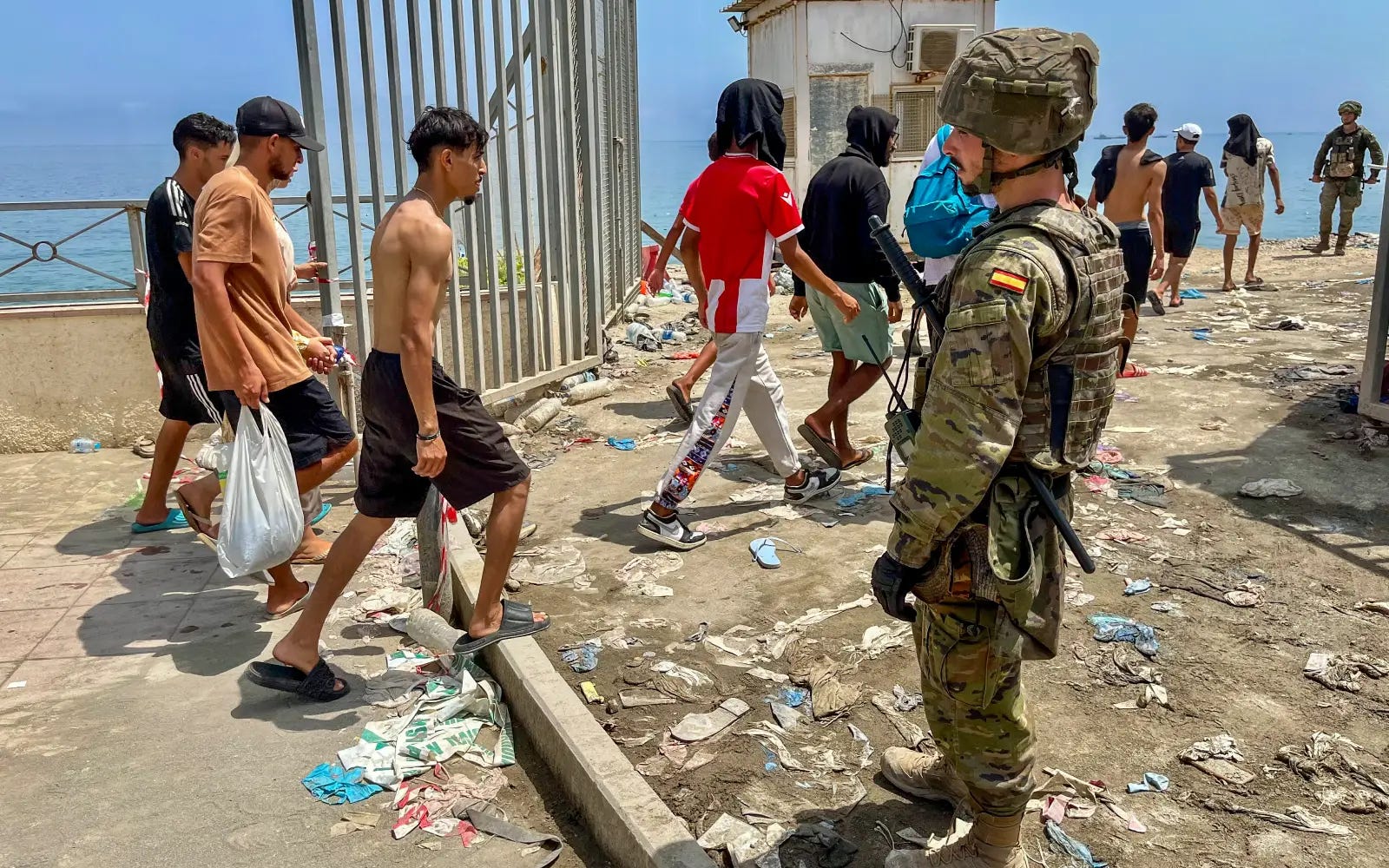
Several thousand remained in Ceuta, where reception centres were overwhelmed and officials were processing 862 unaccompanied minors, according to Spanish official figures.
Spanish Prime Minister Pedro Sánchez quickly identified a culprit. He said an “interested reading” of a Supreme Court judgment had spread “like wildfire” through mafias trafficking in human beings, producing the avalanche. Morocco also blamed digital manipulation, false information, erroneous legal interpretations and human-trafficking networks in its official public account.
What did Spain’s Supreme Court actually decide?
On 8 July, Spain’s Supreme Court upheld a ruling concerning the special procedure used for immediate rejections at the borders of Ceuta and Melilla. The court found that the procedure did not automatically cover migrants intercepted while swimming at sea because they had not crossed the physical containment structures specified by Spanish law, according to the court’s own summary.
The judgment did not open the border and did not give swimmers the right to remain. Yet online, the legal distinction became a much simpler proposition: enter Ceuta by sea and Spain cannot send you back. Migrants interviewed during the crisis described seeing videos of successful crossings and interpreting them as proof that an opportunity existed.
A separate Spanish policy only fuelled the fire. In April, the government opened an extraordinary regularisation process, allowing undocumented migrants already in Spain to apply for residence and work permits. Its terms were strict: applicants had to prove they had arrived before 1 January 2026 and lived in the country for at least five continuous months.
For someone watching fragments of Spanish news from Morocco, the court ruling and regularisation scheme could easily collapse into a single promise: arrive by swimming, avoid immediate removal, obtain papers and work. That promise was false. It was also credible enough to act upon in a country where unemployment among 15 to 24-year-olds reached 37.2 percent in 2025, according to Morocco’s statistics agency.
But from Morocco, watching fragments of Spanish news, the two measures collapsed into one promise: swim to Ceuta, avoid removal, get papers and a job. Every part of that chain was false.
So how are human smugglers involved?
First off, let me clarify a pet peeve of mine. Human smuggling and human trafficking often get used interchangeably. They are not the same.
Human smuggling is a transaction: a migrant pays someone to get them across a border illegally, and the relationship ends once they arrive. Human trafficking is exploitation: a person is moved or held through coercion, deception or debt in order to be used, for labour, sex or other profit, whether or not any border is crossed.
A network dismantled by Spanish police in June 2025 showed how human smugglers operate to Ceuta. Prosecutors alleged the group housed migrants in the Moroccan town of Fnideq, moved them to Ceuta by boat or with swimming guides and underwater scooters, then held them in safe houses inside the enclave until their families completed payment. They charged up to €14,600 person for the full journey, allegedly moved at least 200 people and earned more than €2.5 million, according to the police case summary.
The methods vary with the budget. At the cheap end, migrants are sold a place in an inflatable boat. At the expensive end, powerful jet skis run the ten miles across the Strait of Gibraltar in half an hour, one to three passengers and a pilot at a time.
And Europol has documented how established smuggling groups advertise routes on social media platforms, recruit migrants and facilitators online, then move operational conversations into private messaging services.
Then why weren’t human smugglers to blame this time?
Because almost nothing about the July rush matches how the trade actually works. Human smugglers sell convenience to people who cannot make the crossing alone. But if a rumour has convinced thousands that the border is open and Morocco is letting them reach the water, that convenience disappears. There is little reason to pay thousands of euros for a swim that now looks free.
The documented participants bore this out: they travelled on ordinary trains and taxis, bought or borrowed their own gear, and followed instructions visible to anyone with a phone.
That does not mean smugglers were absent. The more clearly criminal business emerged after the migrnats arrived in Ceuta. Between 1 and 3 August, local reporting documented approximately 50 people reaching Algeciras and La Línea by speedboat and jet ski, mostly from Ceuta. One boat alone carried between 15 and 20 people, while the fast crossings were said to cost between €4,000 and €6,000 per passenger. A 2025 Spanish investigation had already demonstrated the value of this second leg: police alleged that a network held migrants in Ceuta safe houses until their families completed payment, then ferried them to Algeciras.
Smugglers may also have amplified the original rumour. Europol has documented established networks using mainstream social platforms to advertise routes and recruit clients before moving conversations elsewhere. But a familiar method is not proof of responsibility.
The operators of the Haraga Ceuta social media page and the other principal accounts remain unidentified, while both governments offered no supporting evidence when making their allegations.